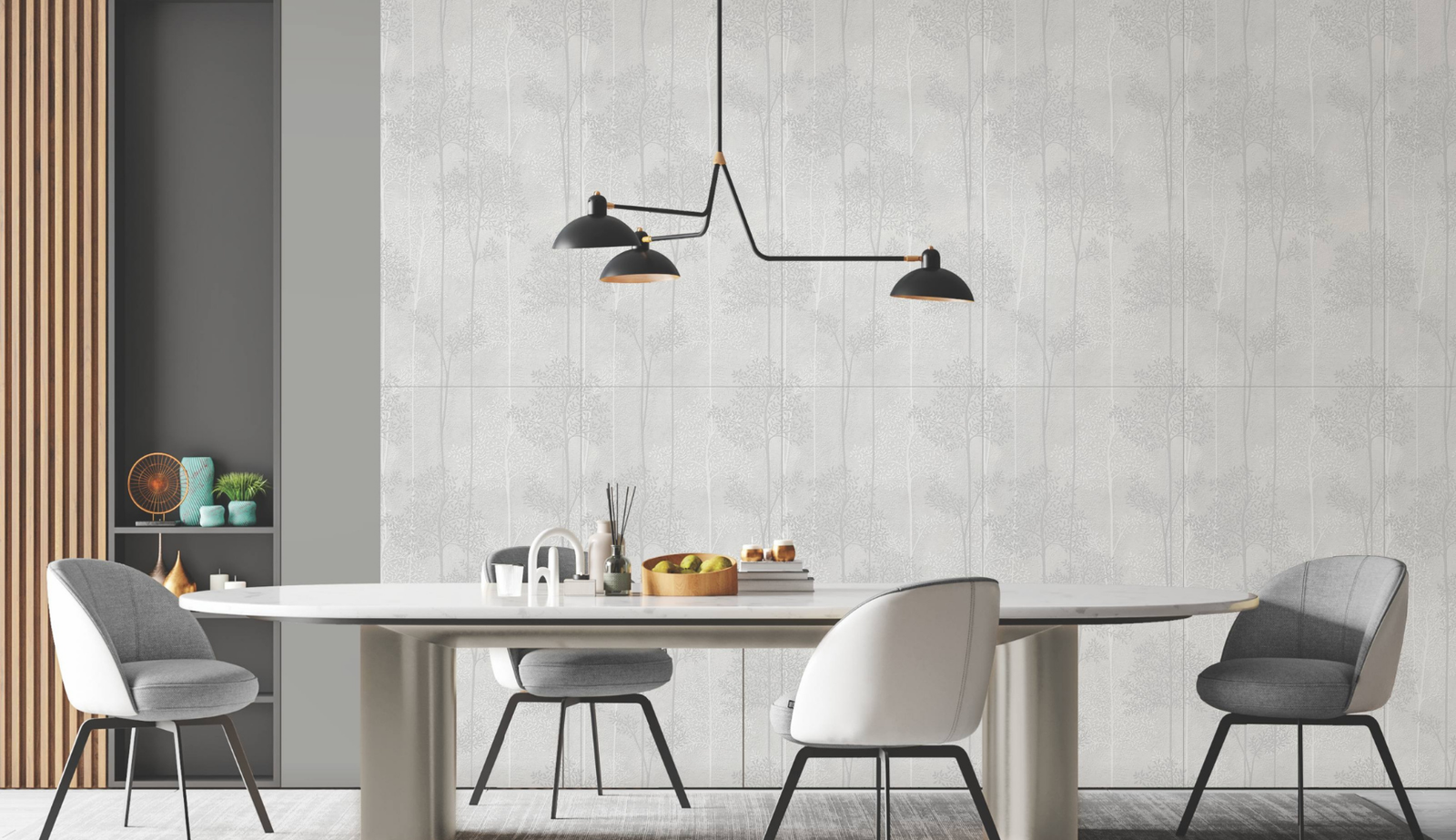



A wall can be treated as a background, or it can become part of the architecture.
Large-format tiles change that relationship because the surface is read less as a collection of individual pieces and more as one continuous material plane.
For architects and interior designers, large format wall tiles are therefore not simply a bigger version of conventional tiles. Scale changes the way joints, graphics, texture, lighting and room proportions are perceived.

Why Scale Matters on a Wall
When the module becomes larger, there are fewer interruptions across the surface. This can make a wall feel calmer and more deliberate, especially in contemporary interiors where visual continuity is important.
| Design Element | Effect of Larger Format |
|---|---|
| Grout Lines | Fewer visual divisions across the wall |
| Veining | More room for stone and marble movement to develop |
| Texture | Relief can be read across a broader surface |
| Room Perception | Can create a cleaner, more continuous material plane |
| Setting-Out | Becomes more important because cuts and joints are highly visible |
600x1200mm Creates an Architectural Module
The 600x1200mm proportion can work horizontally or vertically, giving designers two very different spatial effects.
Horizontal placement
Can reinforce the width of a room, reception backdrop or long feature wall.
Vertical placement
Can emphasise height and create a more monolithic, panel-like composition.
The orientation should follow the architecture rather than being decided only by installation convenience.
Large Format Works Best When the Layout Is Planned Early
Setting-out should happen before installation begins. Architects should consider where full tiles will sit, where cuts will occur, how corners resolve and how the grid relates to furniture, niches, doors and lighting.
A beautiful tile can still produce an ordinary result when the joint layout feels accidental.
Texture Becomes More Powerful at a Larger Scale
Large wall surfaces do not always need stronger colour or pattern. Physical texture can create enough visual interest through shadow alone.
Capron’s Air Plus Collection combines Shape + Matt Granula in a 600x1200mm format, creating a tactile surface where directional lighting can reveal depth.

Use Lighting to Reveal the Surface
Lighting can completely change how a large-format wall is perceived. A flat wash of light may emphasise colour and graphics, while grazing light can reveal texture, carving and relief.
| Lighting Type | Effect on Large-Format Wall Tiles |
|---|---|
| Grazing Light | Highlights relief, texture and shadow |
| Diffuse Light | Creates a softer, more uniform surface |
| Spotlight | Creates focal highlights and stronger contrast |
| Natural Daylight | Changes surface appearance throughout the day |
| Warm Light | Can strengthen beige, earth and wood tones |
Carving and Punch Can Turn the Wall into a Material Feature
Where the design needs more physical depth, carved and punched surfaces can create a stronger relationship between material and light.
Capron’s Origin Collection includes Matt, Carving and Punch surface directions. On a 600x1200mm module, these treatments can be used to create feature walls that depend on surface depth rather than applied decoration.

Glossy Large-Format Walls Create a Different Kind of Impact
Gloss works through reflection rather than relief. In reception areas, formal living rooms, hotel interiors and selected commercial spaces, polished surfaces can amplify light and create a more dramatic material presence.
But reflection should be controlled. Windows, spotlights and surrounding objects can all appear across a glossy wall.

Where Large-Format Wall Tiles Work Well
Living-room feature walls
They can create a strong backdrop without requiring multiple decorative materials.
Hotel receptions
Large surfaces can help establish material identity at the first point of arrival.
Bathrooms
A larger module can create a calmer wall composition, subject to appropriate product selection and installation.
Retail interiors
Fewer visual divisions can keep the architecture quiet enough for products and displays to remain prominent.
Restaurants and cafés
Texture, stone movement or controlled gloss can create atmosphere without adding more objects to the interior.
Large Format Does Not Mean Every Wall Should Be Tiled
Material hierarchy still matters.
One carefully selected large-format feature wall can have more impact than applying the same strong surface across every wall.
Paint, quieter tile surfaces and other materials can be used around the hero wall to create contrast.
Grout Colour Changes the Final Result
With large-format wall tiles, grout may be less frequent, but every joint still affects the composition.
A closely coordinated grout colour can help the surface read more continuously. A contrasting grout colour makes the tile module more visible and should therefore be an intentional design decision.
Plan Corners, Niches and Openings
Large-format walls often intersect with switches, doors, sanitary fixtures, shelving and joinery. These details should be resolved in the drawing stage.
Random cuts around openings can weaken the sense of scale the designer was trying to create in the first place.
Large-Format Wall Tile Specification Checklist
| Specification Item | Question to Resolve |
|---|---|
| Orientation | Should the 600x1200mm module run horizontally or vertically? |
| Setting-Out | Where will full tiles, joints and cuts occur? |
| Surface Finish | Should the wall use gloss, matt, texture, carving or shape? |
| Lighting | How will the lighting reveal reflection or relief? |
| Grout | Should joints blend into the surface or remain visible? |
| Corners | How will external and internal corners be resolved? |
| Openings | How do tile joints align with doors, niches and fittings? |
| Application | Is the selected product recommended for the intended wall condition? |
Common Large-Format Wall Tile Mistakes
Choosing the tile before drawing the layout
The tile module should be coordinated with the wall dimensions before installation.
Ignoring lighting
Texture and gloss can look completely different once the final lighting is installed.
Using too many feature surfaces
Large-format walls are already visually powerful. They need quieter materials around them.
Forgetting switches and fixtures
Small interruptions can become highly noticeable on a broad continuous surface.
Treating grout as an installation-only decision
Joint colour and alignment are part of the architecture.
Scale Should Make the Architecture Clearer
Large-format wall tiles are most effective when scale has a purpose.
The larger module can reduce visual fragmentation, give texture more room to work and allow stone, shape or carving to become part of the architectural language.
Across Capron’s Evolution Surfaces, architects and interior designers can explore multiple 600x1200mm surface directions for walls that need more than a decorative finish.
Frequently Asked Questions
What are large-format wall tiles?
Large-format wall tiles use larger modules than conventional small tiles. Capron’s featured surface collections include 600x1200mm formats that can be used in suitable wall applications.
Are 600×1200 tiles suitable for walls?
They can be suitable for wall applications where the specific product, substrate and installation system support the intended use.
Do large wall tiles make a room look bigger?
Fewer visual joints can create a calmer and more continuous wall plane, which may contribute to a more spacious visual impression. Room proportions, colour and lighting also matter.
Should 600×1200 wall tiles be installed vertically or horizontally?
Either can work. Vertical placement can emphasise height, while horizontal placement can reinforce width. The choice should respond to the architecture and setting-out plan.
What grout colour works with large-format tiles?
A closely coordinated grout can create a more continuous appearance, while contrasting grout makes the tile grid more prominent.
Are textured large-format tiles good for feature walls?
Yes. Texture can create depth through light and shadow, allowing the wall to become a focal point without relying on stronger colour or decoration.
Explore Capron Evolution Surfaces for large-format walls designed around scale, light, texture and architectural intent.
Because when the surface becomes part of the architecture, every joint, shadow and proportion matters.