
The United States is one of the key export markets for tile makers in Morbi, India's main tile cluster, alongside Europe and the Gulf. (BusinessLine) But the cost of bringing a container of Indian tiles into the US is made up of more layers than in most markets: the normal customs duty, a countervailing duty order specific to Indian ceramic tile, an additional duty under Section 301, and US standards for what can be sold as porcelain and how slip resistance is measured. A trade deal between the two countries is close but not yet signed. This guide sets out what a US importer, distributor or project buyer needs to know before ordering porcelain tiles from India, as of late November 2026.
Layer 1: the normal customs duty
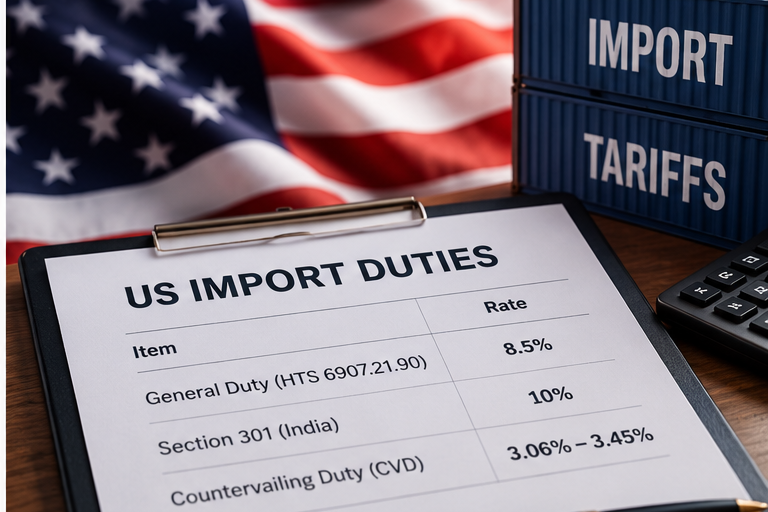
US duty on ceramic tiles depends on how the tile is classified in the Harmonized Tariff Schedule (HTSUS). Porcelain tiles, with water absorption of 0.5% or less, fall under subheading 6907.21. In the current schedule, unglazed tiles under 6907.21.10 carry a general duty rate of 10%. Glazed tiles whose largest surface cannot fit in a 7cm square, which covers ordinary floor and wall tiles including 60x120, fall under 6907.21.90 at 8.5%. Small glazed tiles and mosaics under 7cm have their own lines at 10% or 8.5%. (USITC, Harmonized Tariff Schedule, heading 6907)
Practical advice: confirm the classification with your customs broker before you price the order. It depends on whether the tile is glazed or unglazed and on its water absorption, so ask your supplier for a test report for the exact product.
Layer 2: the countervailing duty order on Indian ceramic tile
In 2025 the US Department of Commerce investigated ceramic tile from India for dumping and for subsidies. The dumping investigation ended with a final negative determination, so there is no anti-dumping order. (Federal Register, 23 Apr 2025) The subsidy investigation was affirmative, and a countervailing duty (CVD) order applies from 16 June 2025. The cash deposit rates are 3.45% for Antiqa Minerals, 3.06% for Win-Tel Ceramics and 3.18% for all other Indian producers and exporters. (Federal Register, Ceramic Tile From India: Countervailing Duty Order, 16 Jun 2025)
The scope is broad. It covers ceramic floor, wall, paving, porcelain, mosaic and decorative tile under 3.2cm thick, glazed or unglazed, whatever the water absorption, and includes slabs and panels larger than one square metre. Tile that has minor processing in a third country, such as cutting, polishing or additional firing, is still covered. (Federal Register)
What this means for you: unless your manufacturer is one of the two companies named, budget for the all-others rate of 3.18% of entered value. CVD rates can change through annual administrative reviews, so ask your broker to confirm the current deposit rate when you place each order.
Layer 3: the Section 301 duty
From 24 July 2026, the US applies an additional 10% duty to most goods from India under Section 301 of the Trade Act, following its forced-labour investigations of 60 economies. India is in the group charged 10%. (USTR, 23 Jul 2026) US Customs guidance says the duty applies to goods entered on or after 12:01 a.m. Eastern Time on 24 July 2026 and that products covered by it remain subject to any anti-dumping or countervailing duties as well. (CBP, CSMS #69326983)
The trade deal: close, but not signed
India and the US announced an interim trade framework in February 2026, but the US Supreme Court later struck down the reciprocal tariffs it was built around. On 18 November, India's Commerce Secretary said the legal agreement is in its final stages but cannot be signed until the US puts a new tariff structure in place and the pending Section 301 investigations, including one into excess industrial capacity, are concluded. (BusinessLine, 18 Nov 2026) Indian officials say the US has promised India a tariff advantage over competitors such as Vietnam, Indonesia and Cambodia, but the size of that advantage depends on those investigations. (BusinessLine, 13 Nov 2026)
Practical advice: price on the duties that apply today. If the deal changes the Section 301 duty before your goods arrive, the saving is a bonus, not part of the plan.
US standards: porcelain and slip resistance
Porcelain. In the US, "porcelain tile" has a precise meaning. Under ANSI A137.1, porcelain tile is ceramic tile with water absorption of 0.5% or less, tested under ASTM C373. The Porcelain Tile Certification Agency (PTCA), set up by the Tile Council of North America and the Ceramic Tile Distributors Association, certifies products that meet this definition. (ANSI Blog)
Slip resistance. The North American industry uses wet dynamic coefficient of friction (DCOF), measured under ANSI A326.3. ANSI A137.1 requires a wet DCOF of at least 0.42 for tile recommended for level interior spaces expected to be walked on when wet. One major US manufacturer's guidance, for example, uses 0.60 or more for exterior wet areas and pool decks and 0.65 or more for ramps. (Daltile, DCOF explained)
Practical advice: if you are selling to US specifiers, ask your Indian supplier for the water absorption test and an ANSI A326.3 wet DCOF result for each design and finish you plan to stock. European R ratings (R10, R11) are useful, but US specifications are usually written in DCOF.
Paperwork at the border
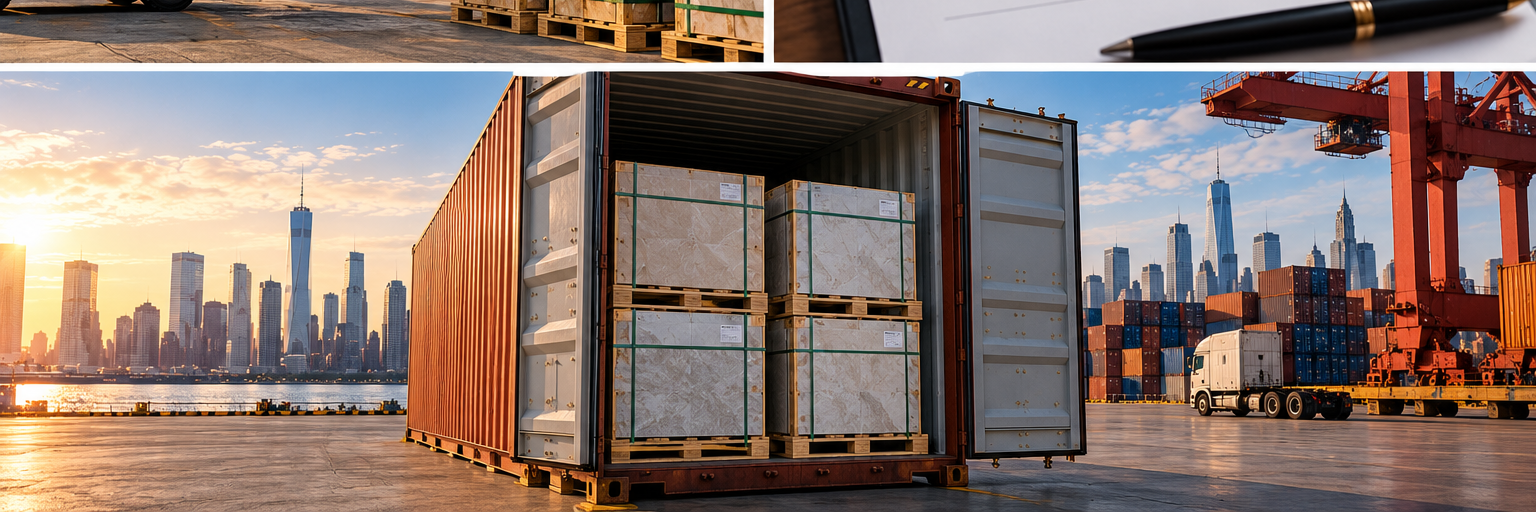
- Importer Security Filing (ISF, "10+2"). For ocean cargo, most ISF data must be filed with US Customs no later than 24 hours before the cargo is loaded on the vessel at the foreign port. (CBP, Importer Security Filing) Make sure your supplier sends the shipping details in time for your broker to file.
- Country of origin marking. Imported goods, or their containers, must be marked with the English name of the country of origin ("India") in a conspicuous and legible way. (19 CFR 134.11)
- Wooden pallets. Wood packaging must be ISPM 15 compliant: treated and carrying the IPPC mark. Non-compliant packaging can be refused entry. (USDA APHIS, wood packaging material)
Freight: rates are falling, surcharges remain
Freight to the US is easing. Drewry's Shanghai–New York rate fell 9% to US$8,194 per 40ft on 19 November, the lowest in 15 weeks, and Drewry expects transpacific rates to fall further. (Drewry World Container Index, 19 Nov 2026) From India, the LogisticsWall index still had North America as the most expensive region in early November, at US$7,841 per 20ft and US$8,741 per 40ft high cube. (LogisticsWall, LW-ICFI November 2026) Maersk's peak season surcharge from Nhava Sheva, Mundra, Pipavav and Hazira to the US East and Gulf coasts (Houston excluded) is US$3,850 per container for non-SPOT bookings from 8 November. (Container News) For more on the India–US lanes, see our earlier note on India–US East Coast freight.
A landed-cost checklist for the US
1. Classify the tile. HTSUS line (glazed or unglazed, water absorption, size).
2. General duty. 8.5% or 10% depending on the line.
3. Countervailing duty. 3.18% for most Indian producers, or the company-specific rate.
4. Section 301 duty. An additional 10% for goods of India.
5. US customs fees. Ask your broker to add the standard entry and harbour fees.
6. Freight. All-in to your port or inland point, with PSS and other surcharges shown separately.
7. Documents. ISF data on time, origin marking, ISPM 15 pallets.
8. Test data. Water absorption and wet DCOF for each product you stock.
Which tiles suit US projects
US demand ranges from homes and multifamily buildings to hotels, offices and retail. From the Capron range:
- Large-format 60x120 is our lead size, for open-plan living areas, lobbies and offices where fewer joints give a cleaner floor.
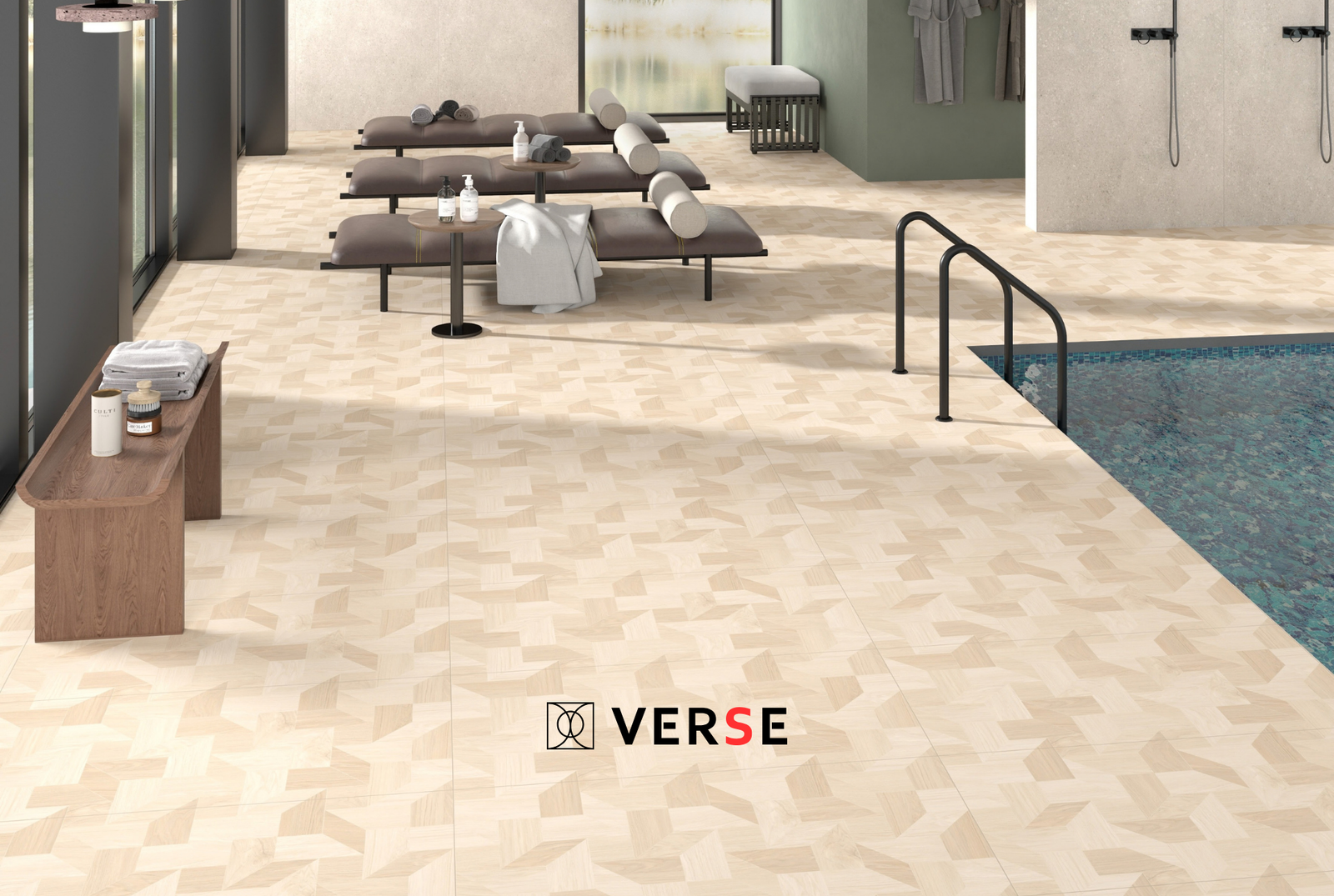
- VERSE is an anti-scratch matt surface for high-traffic areas such as corridors, lobbies and commercial floors.
- NOVA has a GHR (leather-touch) anti-scratch surface designed for bathroom floors, balconies, terraces, pool decks and outdoor corridors.
- FLUX blends natural stone looks with a smooth, satin marble finish and is stain proof; it is advised for home interiors and bathrooms but not high-traffic areas.
- GLOSSY (PGVT) gives a high-shine, premium look with lasting strength.
- The AIR series (AIR, AIR PRO and AIR PLUS) is our 3D/4D range: anti-scratch, with a shape surface and double digital surface, advisable for floor and wall.
- CORE is designed for house and office parking: anti-scratch, acid-proof and able to take car weight.
For wet and outdoor areas, ask for the slip-resistance test results for the exact design and size you plan to use and check them against your project specification.
Questions to ask any Indian supplier before ordering for the US
- What is the water absorption of this product, and can you share the test report?
- Do you have an ANSI A326.3 wet DCOF result for this design and finish?
- Which CVD rate applies to your tiles?
- Can you send ISF data and shipping documents in time for my broker to file?
- Are your pallets ISPM 15 compliant and your cartons marked "Made in India"?
- Which Indian port do you ship from, and can you quote FOB and CIF with surcharges shown separately?
Enquire about Capron tiles for the US
Capron Vitrified, established in 2016, is an ISO and CE certified manufacturer in Morbi, Gujarat, working with over 200 dealers, architects, interior designers and developers. Our lead size is large-format 60x120, with surfaces designed for both residential and commercial projects.
Importers, distributors and project buyers in the US: send your company name, state, sizes and quantities through capronvitrified.com or WhatsApp our export team on +91 76220 25593. We will reply with a quotation, shipping options and the documents your shipment needs.