


For most of 2026, buying tiles from India
has meant paying for a freight market in crisis. This week brought the first clear signs of relief on the main westbound lanes, while Morbi’s factories are back in production after the spring fuel shock. That does not make every lane cheap again, but it does change how a smart importer should time and structure the next order.
What happened this week
On 16 October 2026, The Loadstar reported that container lines are revisiting surcharges and penalties as Indian westbound volumes slow after a strong peak season. Hapag-Lloyd has reportedly cut its cancellation fee for Indian customers to US$100 per container, from the US$300 in force since late July, and the reduction appears to cover its US$300 rollover fee too. Rates from India to Europe and the US are trending down, with expectations that recent elevated levels could halve over the next few weeks. Hapag-Lloyd revised spot rates on one India to US East Coast sailing (leaving JNPA on 24 October) to US$8,000 per 40ft, about US$1,500 lower. (The Loadstar, 16 Oct 2026)
The starting point is still high. The LogisticsWall Indian Container Freight Index stood at US$6,174 per 20ft and US$7,114 per 40ft high-cube on 8 October 2026, up about 394% and 379% respectively since February. (LogisticsWall Indian Container Freight Index, October 2026)
Not every lane is easing. From 1 November 2026, Maersk raises its emergency contingency surcharge from India to South Africa and the Indian Ocean Islands from US$500 to US$1,500 per container, and adds a Durban congestion fee of US$450 per 20ft and US$900 per 40ft. ANL adds US$300 per 20ft and US$600 per 40ft on Indian Subcontinent cargo to Australia from the same date. For the Gulf, Maersk’s Middle East updates still carry emergency freight of US$1,800 per 20ft dry and US$3,000 per 40ft dry, plus a US$1,000 per-container fee for vessels transiting the Strait of Hormuz. (Sattva Global Logistics, India Export Freight Advisory, 16 Oct 2026)

What the export numbers tell buyers
India’s ceramic tile exports have taken a heavy hit this year. Official DGCI&S data compiled by CeramicPost shows April–July 2026 exports (HS 6907) at ₹4,199 crore and 100.1 million square metres, down 33.8% in value and 46.4% in volume on a year earlier. Average realisation rose 23.4% to ₹419 per square metre. (CeramicPost, India Ceramic Tile Exports: Monthly Data)
An Equirus Securities report covered on 17 October links the fall to the Middle East crisis, higher freight and energy costs, trade investigations and disruption at Morbi, where more than 700 factories temporarily shut for over six weeks in March–April after propane and LNG supply from the Persian Gulf was disrupted. By value, exports to GCC markets excluding Saudi Arabia fell 77%, Iraq 95%, Mexico 65%, the US 36%, the EU 24% and the UK 16%, while Russia grew 3%. (ETRealty, 17 Oct 2026)
The supply side has since recovered. CeramicPost, citing Business Standard, reports that propane availability in Morbi has improved materially, most factories are operational, and exports remain subdued on elevated freight, which leaves recovered capacity looking for volume. (CeramicPost, 5 Oct 2026)
The same Equirus report puts India’s average export realisation in 2025 at €3.6 per square metre, against €5 for China, €10.3 for Spain and €16.5 for Italy. India remained the world’s largest porcelain tile exporter by volume in 2025.
Why this matters for tile buyers

Put the pieces together and the picture for Q4 2026 and early 2027 looks like this. Factory capacity in Morbi is available again. Westbound ocean freight to Europe and North America is starting to soften from a very high base. Carriers have less room to stack penalties. But Africa, Australia and the Gulf still carry new or continuing surcharges, so the relief is lane by lane, not across the board.
For importers who paused orders during the spring shutdown and the summer freight spike, this is a window to plan, not a reason to wait indefinitely. Rates that are expected to fall can also bounce, and the Middle East situation that drove this year’s disruption has not been resolved.
What importers should do now?
1. Get a fresh freight quote for your exact lane, not a general market view
“Freight is falling” is true for some routes and false for others. Ask your forwarder for a current all-in rate from Mundra or Pipavav to your discharge port, with every surcharge listed separately and a clear validity date.
2. Separate the factory quote from the freight quote
Ask your Morbi supplier for an FOB price with a defined validity, and price freight separately. That way a freight drop goes straight into your landed cost instead of being hidden inside a CIF number that was set when rates were higher.
3. Check cancellation, rollover and no-show terms before booking
These fees were a big part of the 2026 bill. Hapag-Lloyd’s cut is a sign the market is shifting, and Maersk now auto-cancels eligible bookings that have not materialised five days after the first vessel’s estimated departure (from 15 October, per Sattva’s advisory). Align your production date with the booking so you do not pay for a missed sailing.
4. If you ship to South Africa or Australia, book before 1 November, when you can
The Maersk South Africa surcharge rise, the Durban congestion fee and ANL’s Australia rate restoration all start from 1 November. Confirm with your forwarder whether goods ready earlier can avoid them.
5. Use the recovery to lock specifications and shade lots
With factories running again, the risk is no longer whether goods can be produced, but whether your lot is produced to the right spec on time. Confirm sizes, thickness, finish, shade and calibre marking, packing and pallet labels before production starts.
6. Look at value, not only the lowest price per square
metre
Indian tiles sell at a fraction of Spanish and Italian realisations. For distributors in Europe, the UK and the Americas, large-format glazed vitrified tiles and differentiated surfaces from an organised Morbi exporter can offer a strong price-to-quality step up, especially as freight per square metre comes down.
How Capron Export can help
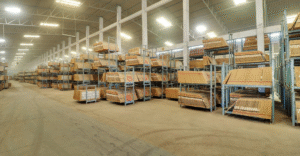
Capron Vitrified is a Morbi-based, ISO and CE-certified manufacturer and exporter of vitrified and ceramic tiles, including large-format 600×1200 mm glazed vitrified ranges. We give clear FOB quotations, confirmed specifications, export packing and documentation, and production dates your forwarder can match to the sailings available on your lane.
Planning an order for Q4 or early 2027? Contact Capron Export or message our export team on WhatsApp at +91 76220 25593. Share your destination city, sizes, finishes and monthly volume, and we will come back with an FOB quote and a production schedule.
————————————————————
Note: Freight rates and surcharges above are taken from the cited reports and change week to week. Confirm current rates, routings and cut-offs with your carrier or forwarder before booking.
————————————————————