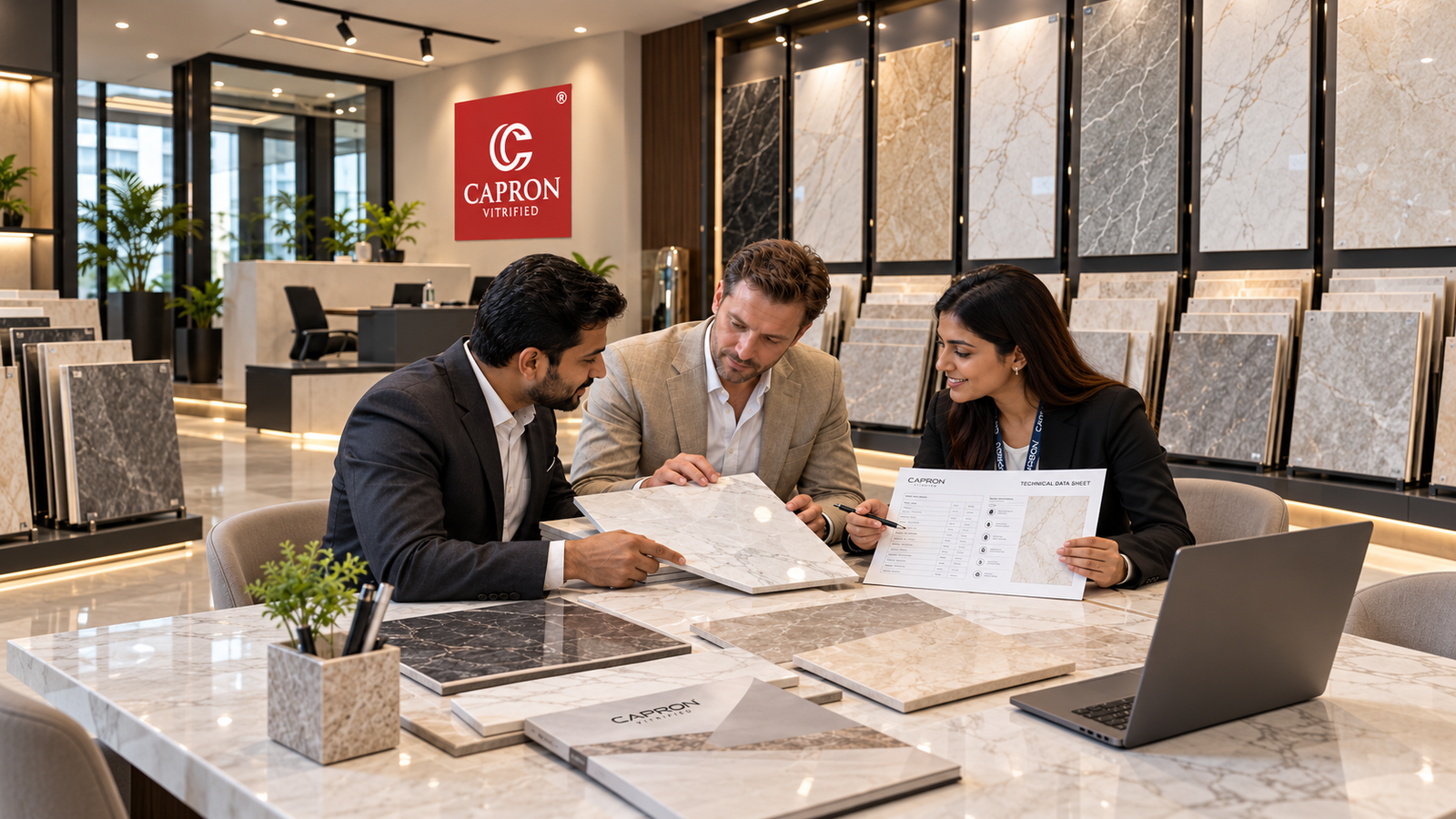



Marble-look tiles and natural marble can both create sophisticated interiors, but they are fundamentally different materials. One is a manufactured surface designed to reproduce or reinterpret the visual language of marble; the other is natural stone with inherent variation created through geological processes.
For architects and interior designers, the useful question is not which material is universally “better”. It is which one aligns with the project’s design intent, maintenance expectations, budget, installation conditions and desired level of natural variation.
First, understand what you are comparing
Natural marble is quarried stone. Its veins, colour shifts, fissures and variations are part of the material itself. Marble-look vitrified tiles are manufactured surfaces whose graphics are designed to evoke marble while providing the characteristics of the specified tile body and finish.
This distinction affects everything from visual consistency to installation planning and maintenance.

1. Natural variation vs designed variation
Natural marble is inherently variable. Two slabs from the same stone family can differ in veining, tone and movement. For some projects, that unpredictability is precisely the appeal.
Marble-look tiles offer designed variation. Depending on the product, multiple faces may be used to reduce obvious repetition. Architects should review the complete product set or catalogue rather than judging the surface from one tile image.
2. Visual consistency
Where a project requires tighter control over colour and pattern across a large area, manufactured marble-look surfaces may offer a more predictable design framework than natural stone. Natural marble requires careful slab selection and sequencing if consistency is important.
Neither approach is automatically preferable. A highly controlled minimalist interior may benefit from consistency, while another concept may celebrate the irregularity of natural stone.
3. Vein planning matters in both materials
Large veins create direction. On floors, they influence how the eye travels through the room. On walls, they can reinforce vertical or horizontal proportions.
Before installation, designers should review orientation and adjacency. With natural stone this may involve slab selection and book-matching strategies; with marble-look tiles it means understanding faces, rotation and the intended tile grid.
4. Large-format marble-look tiles
A 600×1200 mm tile can create a broad marble-inspired field while keeping the module manageable for many interior applications. The format can reduce joint frequency compared with smaller tiles, but it still needs careful setting-out.
Capron PGVT and other 600×1200 mm glossy directions provide options for designers seeking polished, stone-inspired visual movement.

5. Gloss and light response
Polished marble and glossy marble-look tiles both interact strongly with light, but the exact reflection and surface character differ. Windows, pendant lights and furniture may all appear in reflective flooring.
Review samples under the project’s actual lighting direction. A surface that looks restrained under diffuse showroom lighting may become much more active beside full-height glazing.
6. Maintenance expectations
Natural marble and vitrified tile should not be assumed to have identical care requirements. Natural stone may require stone-specific cleaning, sealing or maintenance depending on the material and finish. Tile care depends on the exact product and installation.
For either material, use manufacturer or supplier recommendations rather than generic cleaning assumptions.
7. Installation is different
Natural stone installation involves the characteristics of the selected stone, slab or tile thickness, substrate and stone-specific detailing. Large-format vitrified tile has its own substrate, adhesive, joint and handling requirements.
Designers should coordinate the selected material with an appropriate installation system instead of treating marble and marble-look tile as interchangeable finishes.
8. Use marble-look surfaces beyond the floor
Marble-inspired tiles can work as wall planes, feature surfaces and other appropriate interior applications, subject to the exact product’s intended use. Large-format wall applications can make the vein pattern read more like an architectural surface and less like a small repeated module.

9. Pair marble looks with warmer materials
A polished marble-led palette can become visually cold when every surrounding material is equally hard and reflective. Timber tones, textured fabrics, warmer metals and restrained colour can soften the composition.
Capron TRACE offers wood-inspired surfaces that can provide this kind of material contrast alongside glossy stone or marble-led directions.

10. Consider where authenticity matters to the concept
Some projects specifically require genuine natural stone because provenance, uniqueness and natural variation are central to the design story. Other projects prioritise visual control, tile-format planning or a particular maintenance approach.
The specification should follow that project intent rather than attempting to make one material imitate every characteristic of the other.
Marble-look tiles vs natural marble at a glance
| Consideration | Marble-look vitrified tiles | Natural marble |
|---|---|---|
| Visual variation | Designed graphics and product faces | Inherent natural variation |
| Consistency | Typically more controlled within the selected product | Varies between pieces and slabs |
| Pattern planning | Tile faces, rotation and grid | Slab/tile selection, vein direction and sequencing |
| Maintenance | Follow exact tile manufacturer’s guidance | Follow stone supplier and finish-specific guidance |
| Installation | Tile-specific substrate, adhesive and joint planning | Stone-specific installation and detailing |
| Design character | Controlled marble-inspired expression | Unique natural stone character |
Specification checklist
- Decide whether natural uniqueness or designed consistency is more important.
- Review full-size physical samples whenever possible.
- Study vein direction before finalising the layout.
- Consider reflection under actual project lighting.
- Coordinate the material with adjacent timber, metal, paint and textiles.
- Review maintenance expectations with the client.
- Specify the appropriate installation system.
- Confirm the exact product or stone for the intended application.
Common comparison mistakes
Assuming marble-look tile is natural marble
It is a manufactured surface with a marble-inspired visual. The materials and their characteristics are different.
Assuming natural marble should look perfectly consistent
Natural variation is inherent to stone and should be reviewed during selection.
Choosing from a small digital image
Vein scale, gloss and tonal variation are difficult to assess accurately on screen. Physical samples and larger visual references are important.
Ignoring vein direction during layout
Strong directional graphics can create unintended breaks if tile orientation is not planned.
Frequently asked questions
Are marble-look tiles the same as marble tiles?
No. Marble-look tiles are manufactured surfaces designed to reproduce or reinterpret marble aesthetics, while natural marble is quarried stone.
Can marble-look tiles be used on walls?
Many tile products can be considered for wall applications, but always confirm the exact product’s intended use and installation requirements.
Do marble-look tiles require vein matching?
They do not necessarily require matching in the same way as natural slabs, but vein direction, faces and rotation should still be planned to achieve the intended composition.
Which is better for a modern interior?
That depends on the project. Natural marble offers genuine stone variation, while marble-look tile provides a manufactured, more controlled interpretation. Design intent, maintenance, installation and budget should guide the specification.
Choose the material for the project, not the label
Natural marble and marble-look tiles can both produce strong architectural interiors when specified for the right reasons. The important distinction is understanding what each material actually brings to the project.
Capron PGVT, Ascent, Karbon and complementary Evolution Surfaces provide multiple stone and marble-inspired directions for designers who want to explore polished, expressive 600×1200 mm surfaces.
Explore Capron Evolution Surfaces for marble-inspired interiors designed around scale, light and material intent.