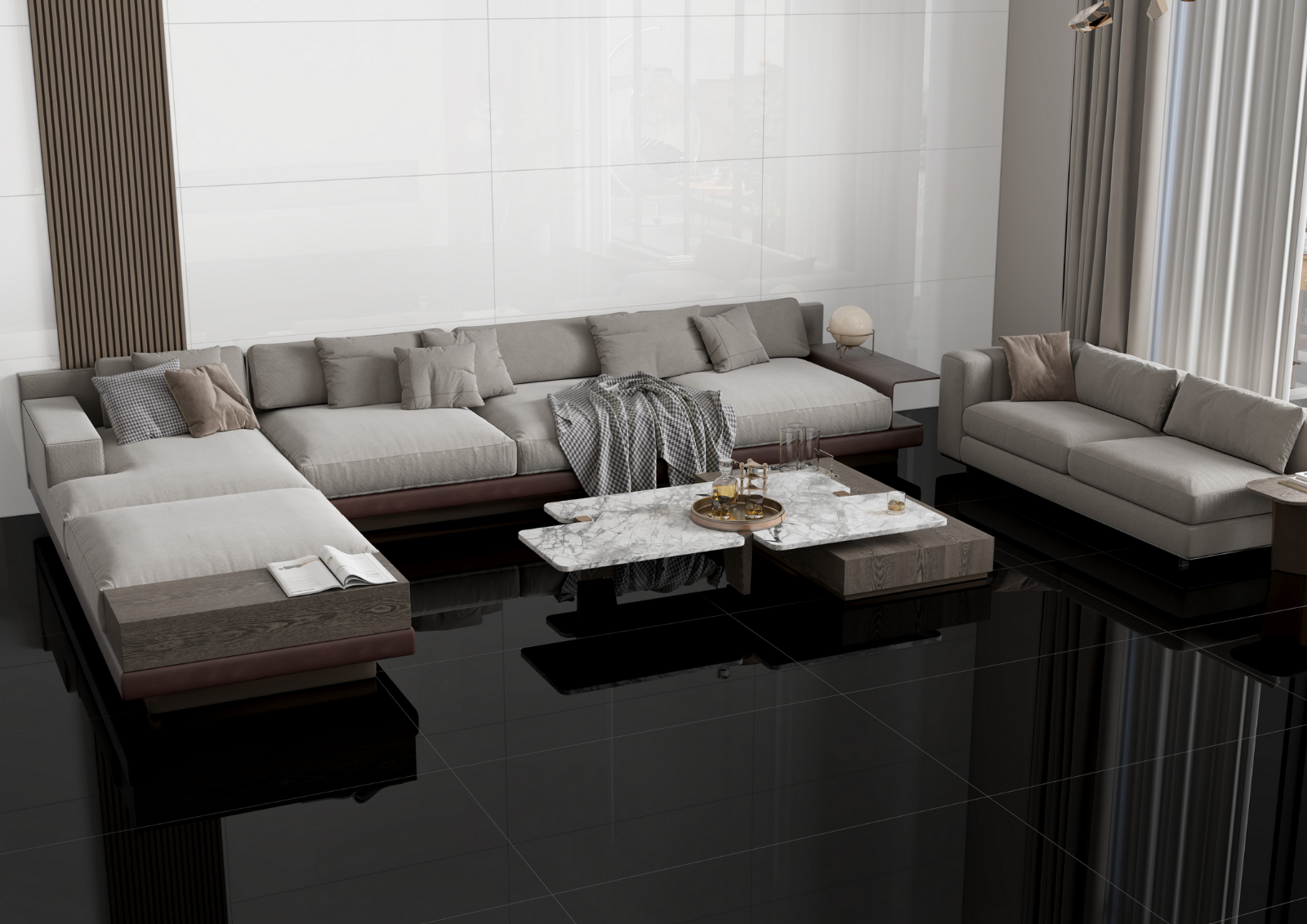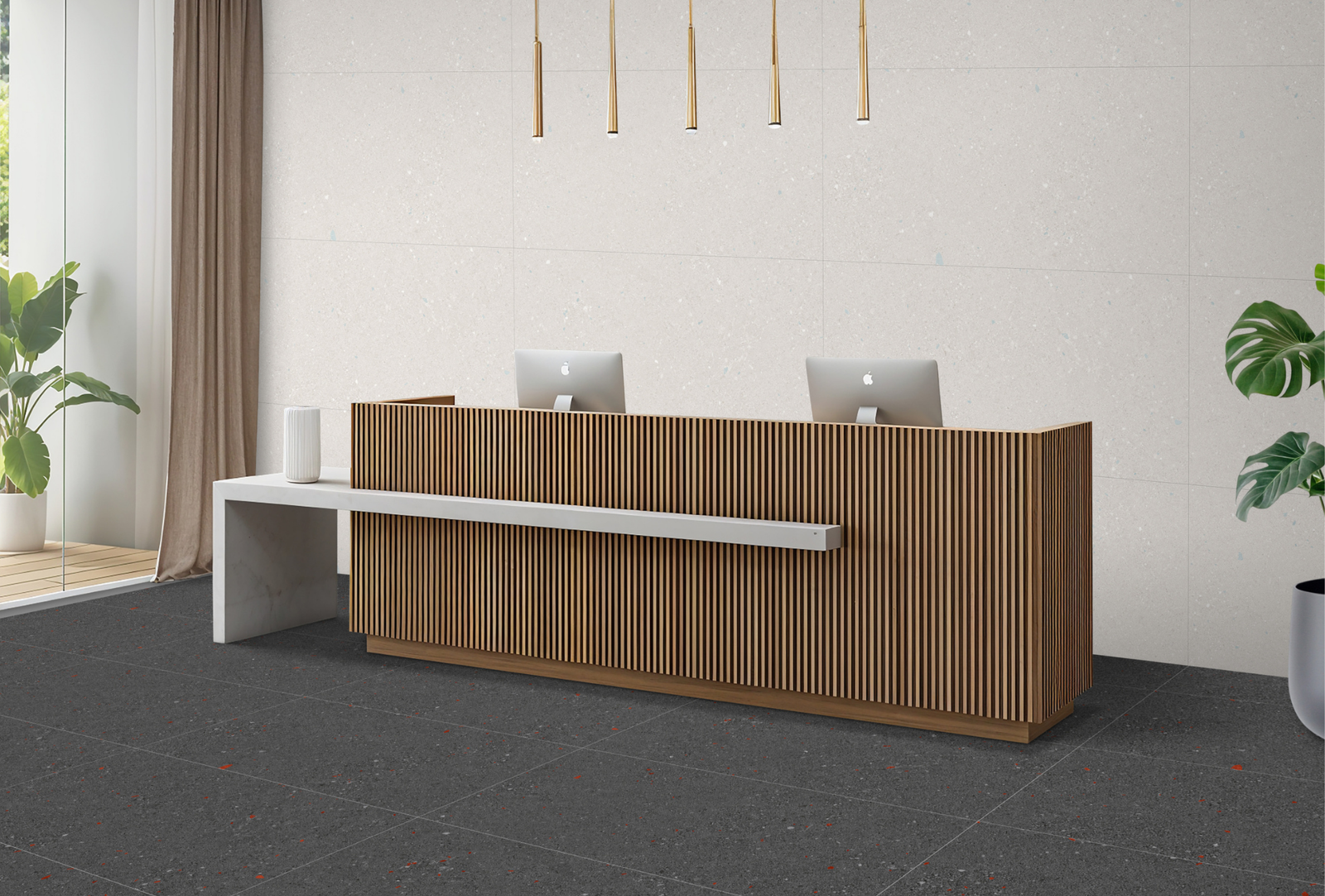

A feature wall does not need another colour. It may need another dimension.
In contemporary interiors, textured wall tiles are increasingly useful because they allow architects and interior designers to create visual depth without relying on excessive pattern, artwork or additional decorative layers.
The surface itself becomes the detail.
Relief, carving, punch, granula and shaped finishes react to light differently throughout the day. A wall that appears restrained under diffused daylight can become more expressive under grazing light in the evening. This gives designers another way to control atmosphere through material rather than decoration.

What Are Textured Wall Tiles?
Textured wall tiles use physical variation across the surface rather than depending only on printed graphics.
The relief may be subtle or pronounced. It may follow a vein, create a geometric rhythm, add granular depth or produce carved details. The important distinction is that the surface changes how light physically falls across the tile.
This gives texture a different role from pattern.
Pattern is primarily visual. Texture is visual and spatial.
Why Architects Use Texture Instead of More Pattern
Many modern interiors already contain multiple materials: timber, metal, glass, upholstery, stone, lighting and joinery. Adding a heavily patterned wall can make the composition feel visually crowded.
Texture offers another route.
Texture adds interest to neutral colours
Beige, ivory, grey and earth tones can remain quiet while physical relief gives the surface depth.
Texture creates hierarchy
A tactile wall can become the focal point while adjacent walls remain simple, allowing the interior to have a clear visual order.
Texture changes with light
Unlike a static printed pattern, the appearance of relief can shift as daylight moves or artificial lighting is changed.
Texture can reduce the need for additional décor
In reception areas, bedrooms, dining spaces and hospitality environments, the wall itself can provide enough character to reduce the need for extra decorative layers.
Light Is Part of the Surface Specification
A textured tile should not be approved without considering how it will be lit.
The same surface can appear almost flat under broad frontal light and significantly more dimensional under directional or grazing light.
| Lighting Condition | Effect on Texture | Design Use |
|---|---|---|
| Diffused daylight | Softens relief and shadow | Calm residential and hospitality interiors |
| Side / grazing light | Emphasises raised and recessed details | Feature walls and reception surfaces |
| Warm artificial light | Deepens beige, sand and earth tones | Lounges, bedrooms and restaurants |
| Focused spot lighting | Creates stronger local highlights | Display, boutique and statement walls |
For designers, this means the wall finish and lighting plan should be developed together. Texture is most effective when it is treated as part of the architecture rather than as a late decorative addition.
600x1200mm Gives Texture More Room to Work
A larger tile format can strengthen the effect of a textured wall because there are fewer interruptions across the surface.
In a 600x1200mm format, relief, carving and graphic movement have enough space to develop before the next joint. This can make the installation read as a broader surface rather than a repeated sequence of small units.
Capron uses the 600x1200mm format across several surface directions, including Shape + Matt Granula in Air Plus and Matt, Carving and Punch treatments in Origin.

Where Textured Wall Tiles Work Best
Reception and lobby walls
A textured wall behind a reception desk can create a strong first impression without competing with signage, furniture or lighting.
Living room feature walls
Behind a sofa, television unit or console, texture can add depth while maintaining a restrained palette.
Bedroom headboard walls
Soft matt and carved surfaces can create a more architectural alternative to wallpaper or upholstered panels.
Bathrooms and spa spaces
Textured surfaces can reinforce a tactile, material-led atmosphere. The specific product’s recommended application and maintenance requirements should always be confirmed before specification.
Restaurants and cafés
Warm lighting across relief can create a richer evening atmosphere and help the wall become part of the hospitality experience.
Retail and display environments
Texture can provide a distinctive background for products while remaining less visually competitive than a bold printed pattern.
Not Every Feature Wall Needs to Be Loud
A common mistake is assuming that a feature wall must use strong colour, dramatic veining or heavy pattern.
For architects and interior designers, a quieter approach can often produce a more sophisticated result.
A surface can become a focal point through shadow, scale and material depth rather than visual noise.

Shape, Matt Granula, Carving and Punch: What Changes?
| Surface Direction | What It Adds | Best Used When |
|---|---|---|
| Shape | Controlled raised or recessed surface form | You want architectural depth and light interaction |
| Matt Granula | Granular tactile character with restrained reflection | You want a softer, more material-led surface |
| Carving | Etched or sculpted detailing | You want veins or motifs to gain physical presence |
| Punch | More pronounced surface relief and grip | You want texture to contribute both visually and functionally |
Capron’s Air Plus catalogue describes its surface as Shape + Matt Granula, while Origin works across Matt, Carving and Punch. Prism’s Decor Punch range is specifically presented for accent areas and feature walls, where bold textures and detailing add depth and character.
Texture Must Still Respect the Material Hierarchy
The strongest surface in a room should have a reason to be strong.
If the floor, ceiling, joinery and feature wall are all highly expressive, the interior loses hierarchy. Texture works best when it is given space to be noticed.
A useful approach is to nominate one hero surface and let the surrounding materials support it.
Hero wall + quiet floor
Use a stronger textured wall with a restrained stone or neutral floor.
Textured wall + simple furniture
Keep cabinetry, upholstery and accessories visually controlled so that the material itself becomes the focus.
Monochromatic palette + varied finish
Use similar tones across several surfaces but vary gloss, matt and relief to create depth without introducing more colours.
When Texture Needs Performance Too
In some projects, tactile character cannot be separated from performance requirements.
High-use areas, bathrooms, balconies and commercial circulation can require greater resistance to wear, marks or slipping depending on the application.
Capron’s Core Collection combines an anti-scratch surface with punch texture in 600x1200mm. The catalogue also describes enhanced traction and references bathrooms, balconies, pool decks and commercial walkways among its applications.

How to Specify Textured Wall Tiles More Intentionally
1. Review the surface under project lighting
Do not rely only on a showroom sample. Evaluate how directional, ambient and natural light change the relief.
2. Plan the joint layout
The texture may be beautiful, but poor setting-out can interrupt the composition. Align joints with architectural elements wherever possible.
3. Consider viewing distance
A subtle texture may work beautifully at close range but disappear across a large lobby. More pronounced relief may be appropriate where the wall is viewed from farther away.
4. Coordinate with furniture and joinery
A strong surface should complement the rest of the space rather than compete with it.
5. Check cleaning and application requirements
More relief can mean more surface variation. Confirm care recommendations and whether the selected tile is appropriate for the intended wall or floor application.
Textured Wall Tile Specification Checklist
| Specification Item | Question to Resolve |
|---|---|
| Surface Type | Shape, matt granula, carving, punch or another texture? |
| Scale | Is the relief appropriate for the viewing distance and wall size? |
| Lighting | How will daylight and artificial light reveal the texture? |
| Tile Format | Does the tile size support the wall proportion and setting-out? |
| Joint Strategy | Should grout visually disappear or reinforce the module? |
| Application | Is the surface suitable for the intended environment? |
| Maintenance | How will the texture affect cleaning and long-term care? |
| Material Hierarchy | Is this the hero surface, or should it remain secondary? |
Common Mistakes with Textured Feature Walls
Using texture on every wall
Texture loses impact when it is everywhere. Select the wall strategically.
Ignoring lighting direction
The wrong lighting can flatten a carefully chosen surface or create harsher shadows than intended.
Choosing texture from a close-up only
A detail image does not show how the surface repeats across a full wall. Review larger layouts and installed references where possible.
Mixing too many surface languages
Carving, wood grain, polished marble and strong graphic patterns can all be beautiful, but not necessarily in the same visual field.
Forgetting the edge condition
Corners, niches, transitions and termination details matter more when the wall surface has visible relief.
The Best Feature Walls Do Not Look Added On
A successful textured wall should feel as though it belongs to the architecture from the beginning.
It should relate to scale, lighting, furniture and circulation. It should have a clear role. And it should still work when the decorative accessories around it change.
This is where surface-led design becomes more powerful than simply adding another layer of décor.
Across Capron’s Evolution Surfaces, designers can work with Shape, Matt Granula, Carving, Punch and other tactile treatments to build walls around light, depth and material character rather than pattern alone.
Frequently Asked Questions
What are textured wall tiles?
Textured wall tiles have physical surface variation such as relief, carving, punch or granular detailing. This allows the wall to interact with light and shadow rather than relying only on printed graphics.
Are textured tiles suitable for feature walls?
Yes. They can create a focal point through material depth, especially in living rooms, bedrooms, reception areas, hospitality spaces and selected commercial interiors.
What tile size works well for textured walls?
The ideal size depends on the wall and design intent. A 600x1200mm format can give texture and graphic movement more room to develop while reducing the number of joints across larger surfaces.
Do textured tiles need special lighting?
No, but directional or grazing light can reveal surface relief more clearly. The final surface should ideally be reviewed under lighting conditions similar to the project.
Are textured tiles difficult to maintain?
Maintenance depends on the depth and type of texture as well as the installation environment. Always review the manufacturer’s care instructions and intended application.
Can architects use textured tiles in commercial projects?
Yes, provided the chosen surface meets the technical and maintenance requirements of the specific application. Hotels, cafés, showrooms, reception areas and retail spaces can all benefit from tactile surfaces when specified appropriately.
Explore Capron Evolution Surfaces for your next architectural or interior project.
Design walls with more than colour. Use scale, texture, light and material depth to create surfaces that belong to the architecture.