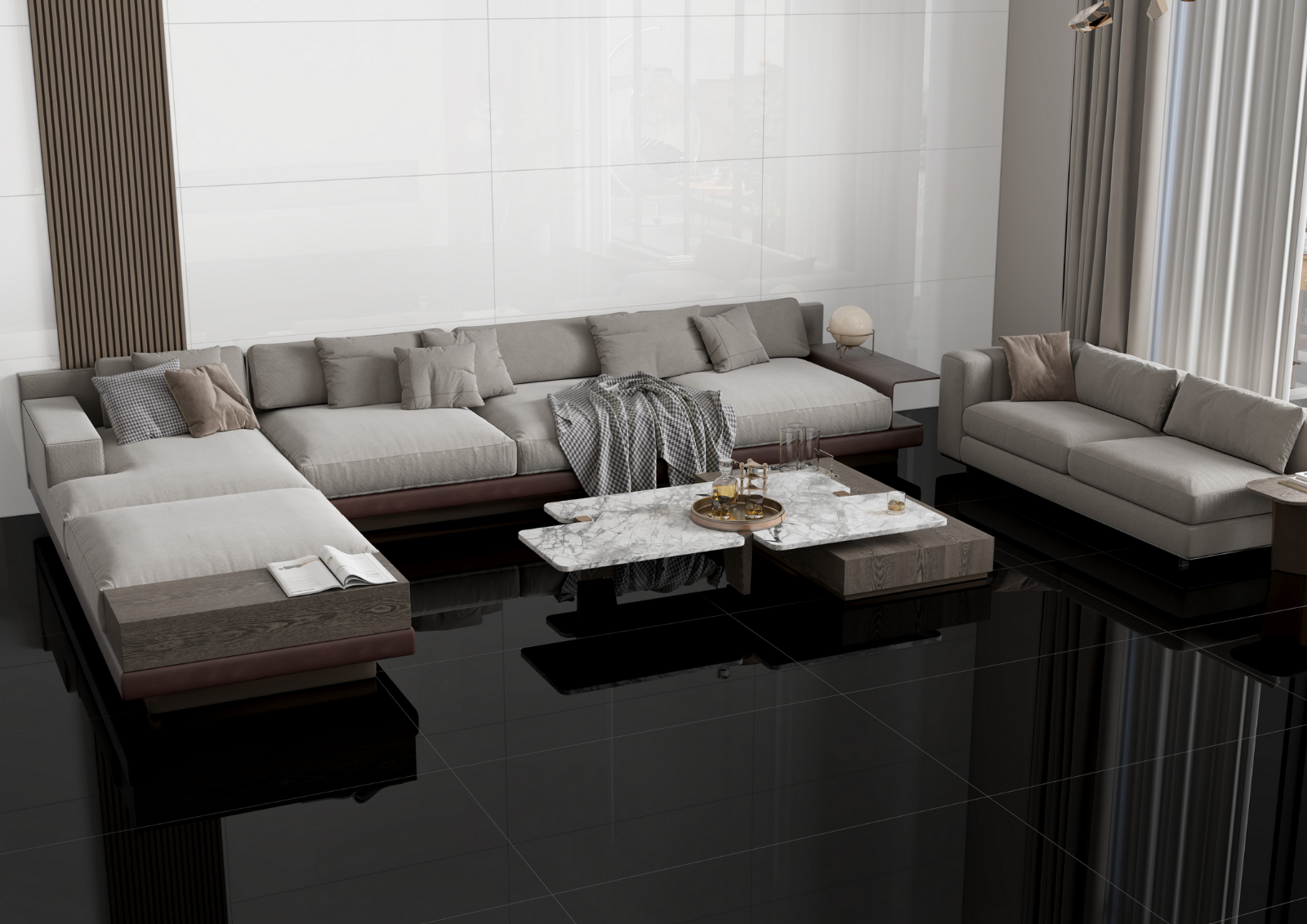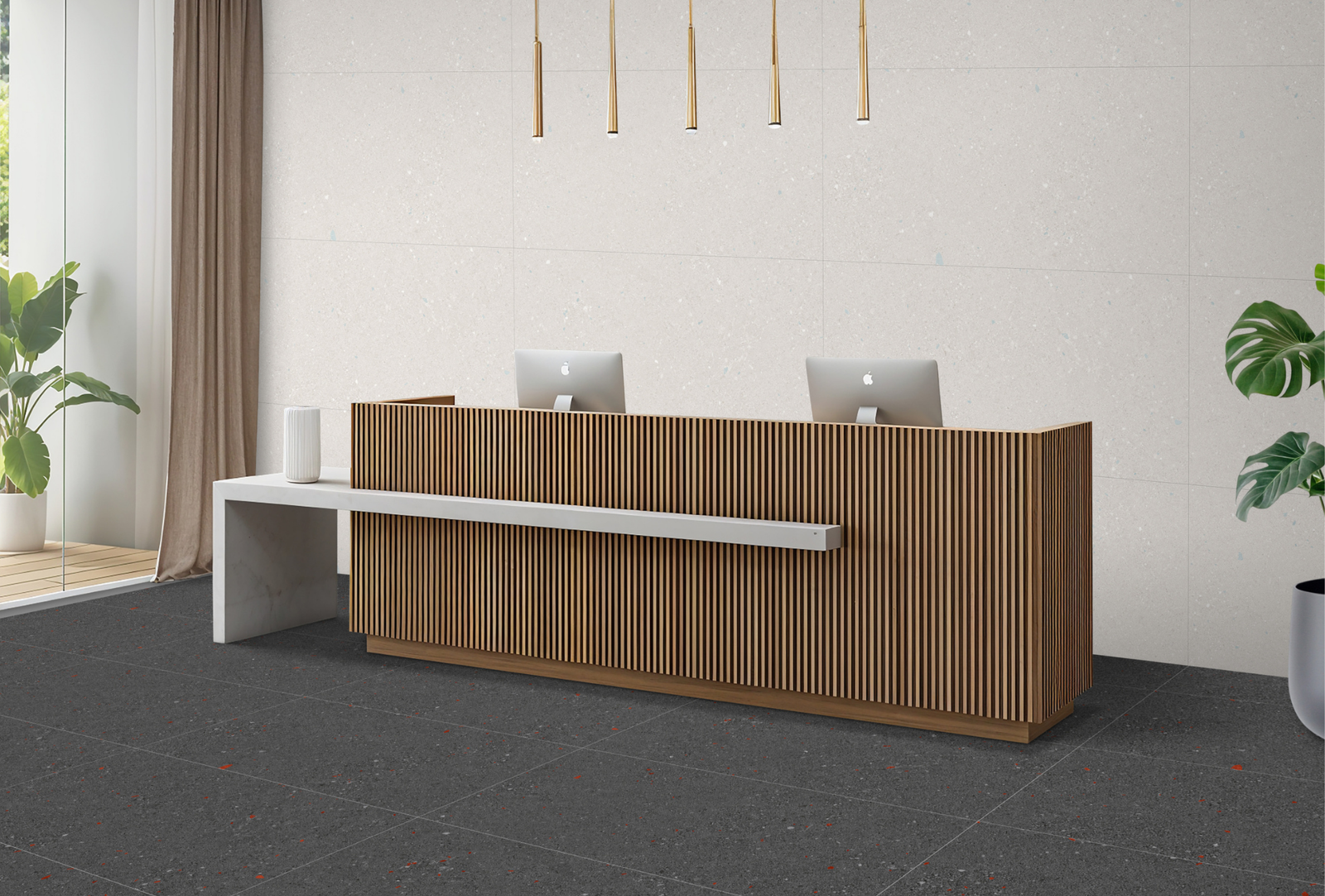



High-traffic interiors are unforgiving.
A surface may look exceptional on handover day, but the real test begins after thousands of footsteps, dragged furniture, cleaning cycles, dust, grit and everyday use.
For architects and interior designers, this is where anti-scratch tiles become more than a product feature. They become part of the performance strategy of the space.
The specification should not begin with “Which tile looks durable?” It should begin with a more useful question: What will this surface actually experience every day?

What Does “Anti-Scratch” Mean in Tile Specification?
Anti-scratch does not mean scratch-proof.
For specification purposes, the better way to understand the term is resistance to the marks, scuffs and abrasions that can result from normal use. The actual performance of any surface depends on the product, installation, environment and type of traffic it receives.
Capron’s Core Collection is presented as a 600x1200mm anti-scratch surface with punch texture. Its catalogue describes resistance against everyday wear and tear, including marks, scuffs and abrasions, for use in high-traffic areas.
Start by Mapping Traffic, Not by Choosing Colour
Before selecting a surface, identify where movement is concentrated.
A reception desk, lift lobby, café aisle, retail entrance and hotel corridor may all belong to the same project, but they do not experience the same intensity or type of traffic.
| Zone | Typical Stress | Specification Focus |
|---|---|---|
| Entrance / Lobby | Frequent footfall, dust and grit | Surface durability, cleaning, visual continuity |
| Retail / Showroom | Foot traffic, display movement, repeated cleaning | Scratch resistance, maintenance and aesthetics |
| Café / Restaurant | Chairs, tables, spills, concentrated circulation | Abrasion resistance, stain response, cleanability |
| Hotel Corridor | Continuous movement, luggage wheels | Long-term appearance and consistent surface performance |
| Balcony / Pool-Adjacent Area | Weather exposure, moisture and movement | Traction, suitability and maintenance |
High-Traffic Does Not Always Mean Commercial
Residential projects can contain intense traffic zones too.
A main entrance, kitchen passage, family living room, terrace connection or parking-adjacent area may experience more daily use than some boutique commercial interiors.
That is why the decision should be based on expected use rather than the label “residential” or “commercial.”
Scratch Resistance and Traction Are Different Questions
One of the most important specification distinctions is that scratch resistance and slip resistance are not the same performance characteristic.
A surface can resist abrasion while still requiring separate consideration for traction, especially in areas where moisture may be present.
The Core catalogue describes a textured surface with enhanced traction and references applications including bathrooms, balconies, pool decks and commercial walkways.

Why Surface Texture Matters in High-Use Areas
Texture can contribute to both the visual and functional character of a floor.
A completely smooth, highly reflective surface communicates something very different from a punched or tactile finish. In a high-use environment, the selected texture should support the project concept without ignoring maintenance or circulation requirements.
Capron’s Core range combines its anti-scratch treatment with a punch surface, allowing a stone-inspired aesthetic to retain physical character.
Large Format Can Still Work in Demanding Spaces
High-traffic does not automatically require a small tile format.
A 600x1200mm surface can create fewer visual joints and a more continuous floor plane when the format is appropriate for the site, substrate, installation method and design.
For architects, the important questions are setting-out, transitions, movement joints, edge conditions and how the module relates to the architecture.
Large format is not a shortcut to a seamless look. It still requires disciplined planning.
Parking, Garage and Utility-Adjacent Areas Need a Different Conversation
Some project zones carry concentrated loads, dust, tyre movement and more aggressive everyday use.
These spaces should be reviewed separately from a living room or reception wall, even if the overall material palette is connected.

The visual language can remain consistent across a project, but the selected surface needs to respond to the actual conditions of each zone.
What Architects Should Check Beyond “Anti-Scratch”
| Specification Factor | Why It Matters |
|---|---|
| Expected Traffic | Defines the intensity and type of wear the floor is likely to experience. |
| Surface Texture | Affects touch, appearance, traction and cleaning behaviour. |
| Moisture Exposure | Wet or semi-wet zones may require additional traction considerations. |
| Cleaning Regime | Commercial cleaning frequency and methods can influence long-term appearance. |
| Tile Size | Must work with room dimensions, substrate, layout and installation planning. |
| Joint Strategy | Grout colour and joint planning affect both appearance and maintenance. |
| Transitions | Thresholds and adjacent materials should be resolved before installation. |
| Manufacturer Guidance | Always confirm the recommended application and care instructions for the selected product. |
Durability Should Not Force a Project into an Industrial Aesthetic
Performance-led specification does not mean accepting a visually ordinary surface.
High-traffic floors can still contribute to the architecture through stone-inspired tones, layered colour, texture, scale and considered laying patterns.
The Core Collection includes designs such as Abbey Grigio, Abbey Silver, Cave Stone, Drystone Beige, Drystone Ivory, Drystone Nero, Geostone Grey, Geostone Lava, Kota Stone Green and Viastone options, all presented with an anti-scratch with punch surface in 600x1200mm.
This gives designers room to think about durability and material character together rather than treating them as opposing priorities.
Commercial Interiors Need Long-Term Visual Discipline
A café, showroom or retail interior is photographed on opening day, but experienced for years.
This changes the value equation of the floor.
A surface that maintains its visual character under repeated movement can support the brand environment long after the initial launch moment.

Design the Maintenance Strategy at Specification Stage
Maintenance should not be left entirely to the operations team after handover.
The designer should understand how often the area will be cleaned, what kind of dirt it will receive, whether loose grit is likely to enter the space and how furniture will be moved.
This helps avoid specifying a visually impressive surface that becomes difficult to manage in real use.
Entrance zones
Consider how dust and grit are controlled before they travel deeper into the space.
Hospitality areas
Think about chair movement, spills and repeated cleaning.
Retail spaces
Account for fixtures and displays that may be repositioned over time.
Residential common areas
Understand family movement, pets, furniture use and connections to outdoor zones.
Do Not Confuse “Premium” with “Delicate”
A premium interior should not need to be protected from normal life.
For architects and interior designers, material quality is not only what the client sees under perfect lighting. It is how the surface continues to perform once the building is occupied.
This is particularly important in projects where the visual language depends on calm, uninterrupted floor planes. Damage, scuffs or visibly inconsistent wear can undermine the design far more than an additional decorative element can improve it.
Anti-Scratch Tile Specification Checklist
| Step | Architect / Designer Check |
|---|---|
| 1 | Map low, medium and high-traffic zones before selecting finishes. |
| 2 | Identify moisture, dirt, furniture and maintenance conditions for each zone. |
| 3 | Review scratch resistance separately from traction and other performance requirements. |
| 4 | Choose the tile format according to the architectural grid and setting-out plan. |
| 5 | Review multiple faces, colour variation and texture at a useful scale. |
| 6 | Coordinate grout, thresholds and transitions with adjacent materials. |
| 7 | Confirm the manufacturer’s intended application and maintenance guidance. |
| 8 | Where possible, review a mock-up under actual project lighting and use conditions. |
Common Mistakes in High-Traffic Tile Specification
Assuming all “durable” tiles perform the same
Different surfaces are designed around different characteristics. Review the actual product information rather than relying on a broad category label.
Using one finish across every zone
Material continuity is valuable, but each area may require a different performance response.
Ignoring grit and dirt at entrances
Real-world abrasion often begins with what is carried into the building. Entrance planning and maintenance remain important even with a resistant surface.
Selecting from appearance alone
A high-traffic floor is a technical and operational decision as much as an aesthetic one.
Calling anti-scratch “scratch-proof”
Resistance should not be confused with immunity. Specify within the manufacturer’s documented performance and usage guidance.
Performance Is Part of the Design Language
The best high-traffic interiors do not look as though durability was solved after the design.
The performance is embedded into the material strategy from the beginning.
Scale, colour, texture, circulation and resistance all work together. This allows architects and interior designers to create demanding spaces without defaulting to generic or purely utilitarian surfaces.
Within Capron’s Evolution Surfaces, the Core Collection approaches this through a 600x1200mm anti-scratch with punch surface designed around durability, texture and a stone-inspired visual language.
Frequently Asked Questions
What are anti-scratch tiles?
Anti-scratch tiles are surfaces designed to resist everyday marks, scuffs and abrasions. The exact performance depends on the product and application, so manufacturer documentation should guide specification.
Are anti-scratch tiles scratch-proof?
No. Scratch resistance should not be described as complete scratch immunity. Usage, grit, furniture movement and maintenance practices can all influence surface wear.
Are anti-scratch tiles suitable for commercial interiors?
They can be useful in high-use commercial environments when the selected product is recommended for the intended application and meets the project’s other requirements.
What tile size is available in Capron Core?
The Core Collection is presented in a 600x1200mm format with an anti-scratch with punch surface.
Where can textured anti-scratch tiles be used?
The Core catalogue references homes and commercial spaces and also describes applications including bathrooms, balconies, pool decks and commercial walkways. Final specification should always follow the selected product’s intended use.
What should architects consider for high-traffic flooring?
Consider traffic intensity, abrasion, moisture, traction, cleaning frequency, tile size, setting-out, joints, transitions and the manufacturer’s application guidance.
Explore Capron Evolution Surfaces for architectural and interior projects where performance matters as much as design.
Specify for the space as it will actually be used, not only for how it looks on day one.