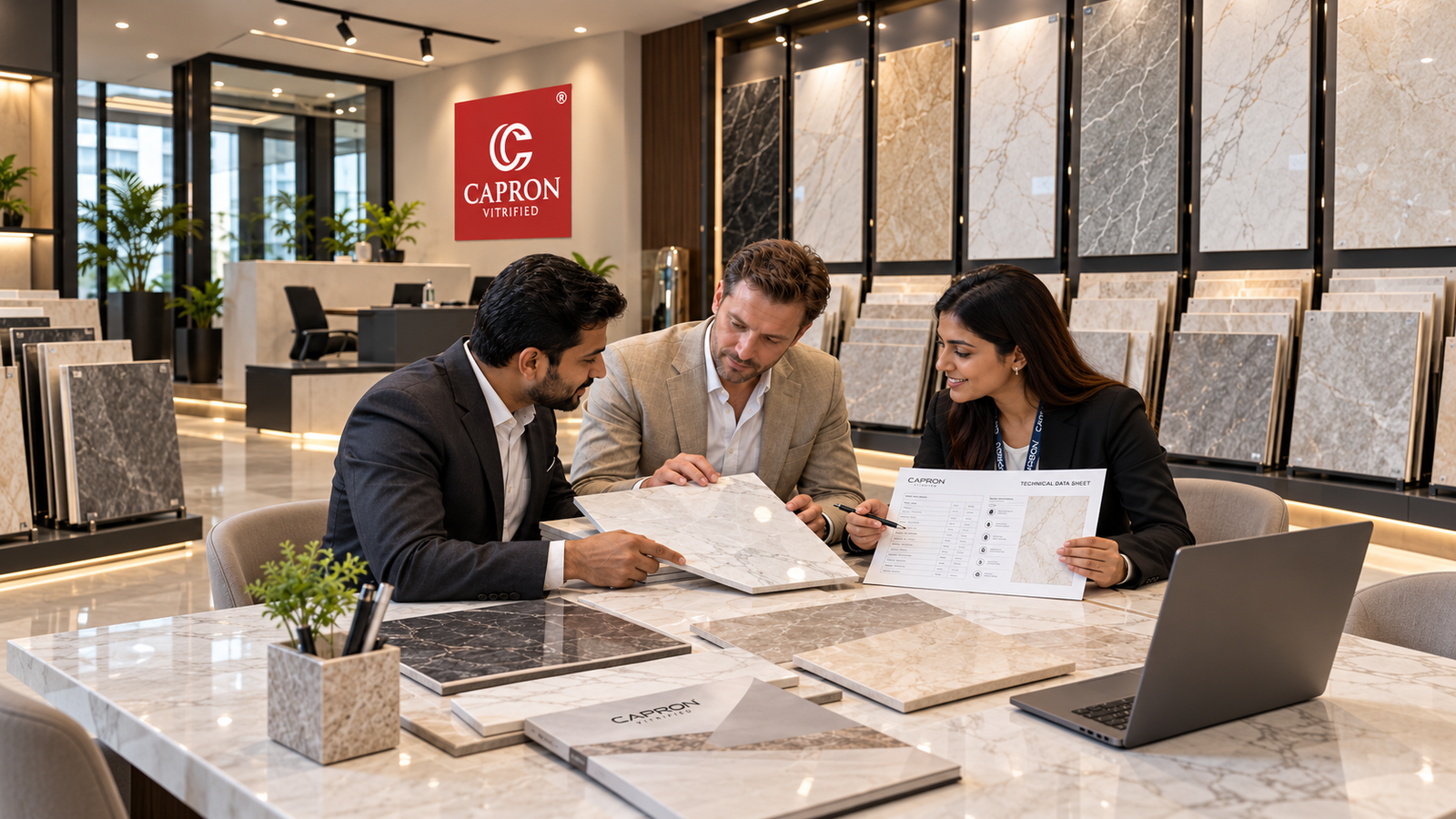



Commercial interiors are judged twice.
First, by how they look when the project opens. Then, by how they perform after months and years of use.
That second test changes everything.
A showroom floor, hotel lobby, café, retail store or office corridor may need to handle constant movement, furniture, cleaning, moisture, dust and repeated daily use while still maintaining the visual language of the project.
For architects and interior designers, choosing the right tiles for commercial spaces is therefore not a styling exercise. It is a specification decision involving traffic, scale, finish, maintenance, lighting and long-term material behaviour.

Start with the Commercial Use, Not the Tile Catalogue
The most useful way to specify a commercial surface is to begin with what happens in the space.
A luxury boutique, café, hotel corridor and office reception may all use vitrified tiles, but the stresses placed on those floors and walls are different.
| Commercial Zone | Typical Use | Specification Priority |
|---|---|---|
| Hotel Lobby | Continuous footfall, luggage, visual first impression | Durability, scale, visual continuity, maintenance |
| Retail Store | Foot traffic, display movement, lighting changes | Surface durability, brand character, cleanability |
| Café / Restaurant | Chairs, tables, spills, repeated cleaning | Maintenance, stain response, circulation, finish |
| Showroom | Visitors, merchandise, bright lighting | Reflection, scale, long-term appearance |
| Office Reception | Moderate to high footfall, formal presentation | Visual restraint, easy maintenance, consistency |
| Commercial Walkway | Constant movement | Performance, traction, durability and joint planning |
High-Traffic Floors Need Performance Built into the Design
The busiest areas of a project should not be specified with appearance alone in mind.
Footfall, dust, grit, furniture movement and cleaning cycles all influence long-term surface quality.
Capron’s Core Collection is designed around a 600x1200mm anti-scratch with punch surface. The collection is positioned for high-traffic environments and references applications including commercial walkways, balconies, bathrooms and pool decks.
For commercial projects, this type of surface direction allows durability and material character to be considered together rather than as separate decisions.
Gloss Can Be Powerful, but It Needs Control
Glossy surfaces can make a commercial interior feel brighter, more polished and visually expansive.
This can work particularly well in formal reception areas, premium showrooms and selected hospitality spaces where reflected light supports the concept.

But strong reflection should be intentional.
Large glazing, spotlights and linear lights can create glare or highly visible reflections on polished surfaces. Architects should review samples under lighting conditions similar to those planned for the site.
Textured Surfaces Create Identity Without Visual Noise
Commercial interiors often need a strong identity, but not every surface should compete for attention.
Textured tiles can add depth through relief rather than through louder colour or pattern.
Capron’s Air Plus Collection uses Shape + Matt Granula in 600x1200mm and is presented for applications including hotels, showrooms, spas and cafés.

For reception walls, display areas, hospitality zones and feature surfaces, texture can become part of the architecture while adjacent materials remain visually controlled.
Wood-Look Tiles Can Warm Retail and Hospitality Interiors
Commercial spaces often combine hard materials such as glass, metal, stone and ceramic. Without contrast, the environment can feel cold.
Wood-look tiles introduce grain, linearity and warmth while preserving a tile-based surface system.
Capron’s Trace Collection is inspired by natural wood grains and is positioned for both residential and commercial interiors.

Which Tile Finish Works for Which Commercial Space?
| Space | Possible Surface Direction | Why |
|---|---|---|
| Premium Showroom | Glossy or polished | Can amplify lighting and create a refined visual impression |
| Hotel Reception | Polished floor + textured feature wall | Combines formal presentation with material depth |
| Café / Restaurant | Matt, textured or performance-led floor | Supports repeated use and a warmer atmosphere |
| Retail Store | Neutral floor + wood or textured wall | Lets products remain visually dominant |
| Office Reception | Large-format neutral surface | Creates calm continuity and a professional base |
| High-Traffic Walkway | Anti-scratch / punch surface where appropriate |
Addresses wear while retaining surface character |
600x1200mm Can Create Strong Commercial Continuity
Large-format tiles can help commercial interiors feel more deliberate because they reduce the number of visual interruptions across a wall or floor.
The 600x1200mm format gives veins, texture and tonal movement more room to develop while offering a clear module for architectural planning.
For architects, the format can also help create continuity between connected commercial zones, provided the setting-out, substrate, movement joints and transitions are resolved correctly.
Material Hierarchy Matters More in Commercial Interiors
Commercial spaces usually contain signage, merchandise, furniture, lighting, branding and wayfinding.
If every surface is visually strong, the project can become noisy.
A better approach is to decide which material should lead and which surfaces should support it.
Retail
Keep the floor calm if the products and display walls are already visually active.
Hospitality
Use stronger material moments at reception, bars or focal areas while circulation surfaces remain more restrained.
Showrooms
Consider how reflections, grout lines and surface pattern interact with the product being displayed.
Offices
Use material continuity to create professionalism and spatial clarity rather than overdecorating common areas.
Maintenance Is a Design Decision
Commercial interiors are cleaned more frequently than most residential spaces.
This makes maintenance strategy part of material selection.
Before approving a surface, designers should understand how often the space will be cleaned, what types of dirt or spills are likely, how furniture will move and whether the chosen texture is practical for the environment.
What Architects Should Check Before Specifying Commercial Tiles
| Specification Item | Question to Resolve |
|---|---|
| Traffic | How many people use the space, and where is movement concentrated? |
| Surface Finish | Should the surface reflect light, diffuse it or create tactile depth? |
| Performance | What abrasion, moisture, traction or maintenance conditions apply? |
| Format | How does the tile module relate to the architectural grid and room size? |
| Lighting | How will daylight and artificial light change the appearance of the finish? |
| Grout | Should joints disappear visually or reinforce the layout? |
| Transitions | How will the tile meet entrances, other floor materials and level changes? |
| Maintenance |
What cleaning frequency and operational conditions will the surface face? |
Commercial Tiles Should Support the Brand Experience
In commercial design, the floor and walls are not neutral background elements.
They influence how premium, warm, energetic, calm or technical the brand feels.
A luxury showroom may benefit from reflective stone-inspired surfaces. A café may need warmer textures. A modern office may require controlled neutral continuity. A boutique can use wood grain to soften a highly designed display system.
The right surface does not simply survive the space. It participates in the brand experience.
Common Mistakes in Commercial Tile Specification
Using residential logic in high-use commercial areas
The expected traffic, cleaning and furniture movement can be completely different.
Choosing shine because the project is premium
Luxury can come from proportion, restraint and texture just as easily as reflection.
Ignoring the lighting plan
Gloss, texture and colour can all look significantly different once the final lighting is installed.
Overdesigning every zone
A commercial project needs hierarchy. Not every wall or floor should become a statement surface.
Leaving joint layout to site
Grout lines, cuts and transitions can undermine even an expensive surface if the setting-out is not planned.
The Best Commercial Surfaces Work After Opening Day
A commercial interior is not complete when the photographs are taken.
It is complete when the design continues to work under real use.
For architects and interior designers, that means selecting surfaces that balance visual identity with performance, maintenance, scale and long-term consistency.
Capron’s Evolution Surfaces offer multiple 600x1200mm directions across glossy, textured, anti-scratch and wood-inspired finishes, giving designers the flexibility to specify according to the needs of each commercial zone rather than relying on one generic solution.
Frequently Asked Questions
Which tiles are best for commercial spaces?
The best option depends on traffic, maintenance, moisture, lighting and the intended visual character. Commercial projects should be specified according to the actual use of each zone rather than one general tile type.
Are vitrified tiles suitable for commercial interiors?
They can be suitable for many commercial applications when the selected product is recommended for the intended use and meets the project’s performance requirements.
What tile size works well in commercial spaces?
A 600x1200mm format can create strong visual continuity and give textures or veins more room to develop, but the correct size depends on room dimensions, substrate, layout and installation planning.
Are glossy tiles suitable for showrooms?
Glossy tiles can work well in selected showroom environments where reflection and brightness support the design. Lighting, glare, maintenance and traffic should still be considered.
What should architects consider for commercial floor tiles?
Review traffic, abrasion, maintenance, traction, moisture, tile format, grout, transitions and the manufacturer’s recommended application before final specification.
Can textured tiles be used in cafés and hotels?
Yes. Textured surfaces can create strong material character in hospitality environments, provided the selected product is suitable for the intended wall or floor application.
Explore Capron Evolution Surfaces for commercial projects that demand both design character and long-term performance.
Specify each zone for the way it looks, the way it works and the way it will be experienced every day.